Your pocket aviation expert

Point your phone at any plane.
Know its story.

See a cool aircraft on the ramp? Snap a photo. Fly-in Spotter identifies the aircraft type, reads the tail number when it can to pin down the exact airframe, and hands you a tour-guide story — in seconds.

Spot an aircraft
Point your camera at any plane
Camera Library
Identifying…
Exact match · FAA registry

Cessna 172 Skyhawk

N7818B · 1956 · Single-engine piston
How it works

Three taps from curious to expert

No spotter's guide, no squinting at tail numbers, no typing. Just point and learn.

Snap a photo

Point your camera at any aircraft — on the ramp, in the pattern, or in your camera roll.

We identify it

AI reads the photo to identify the aircraft type — and, when the tail number is legible, pins down the specific airframe in the US & Canadian registries.

Get its story

Make, model, year, engine — plus a fun, written tour-guide story about that aircraft. Save it to your logbook and pin it on the map.

See it in action

Here's what you actually get

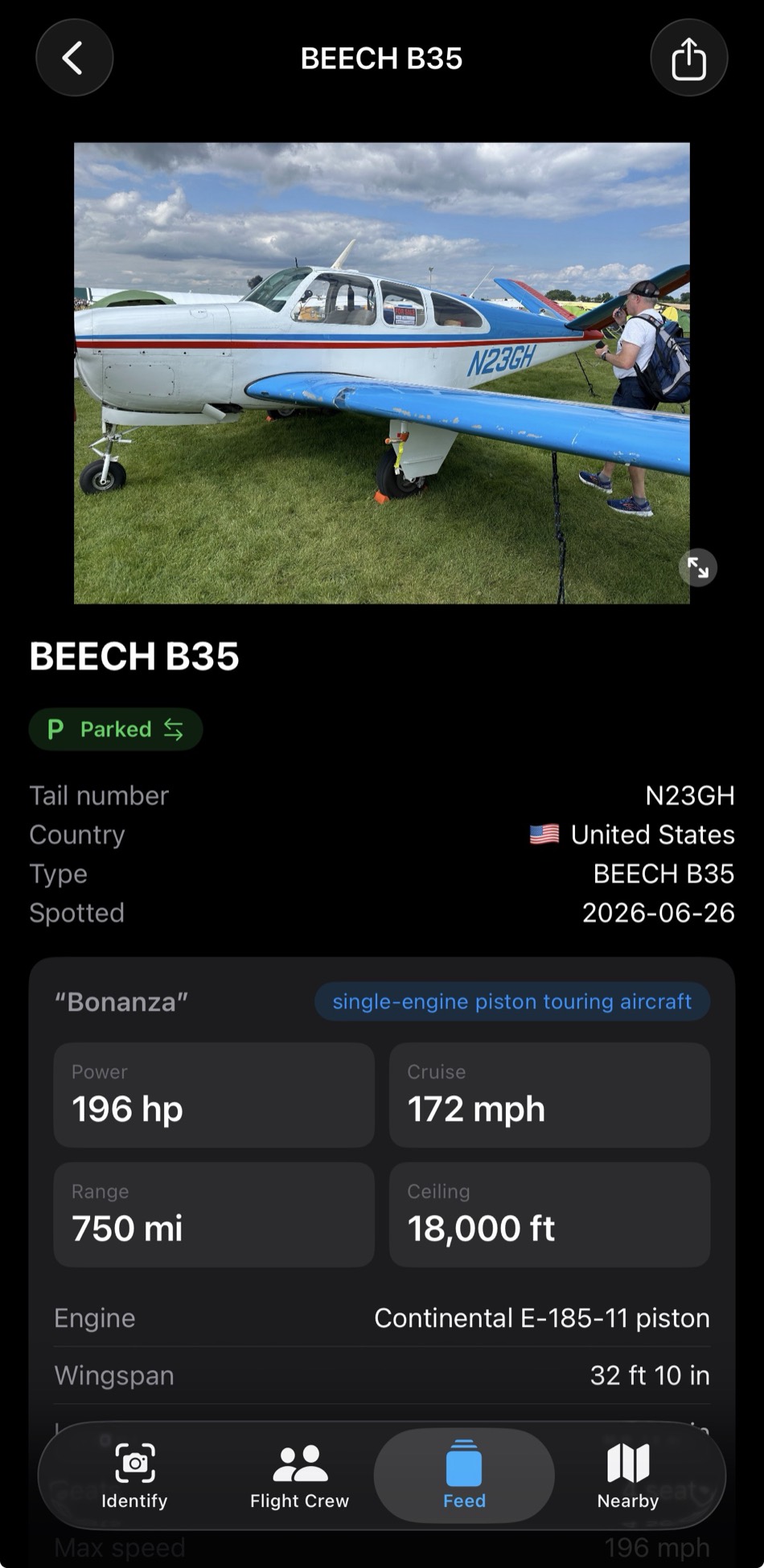
A real result from the app — the exact airframe and its spec card. Tap the phone to flip to the full tour-guide story.

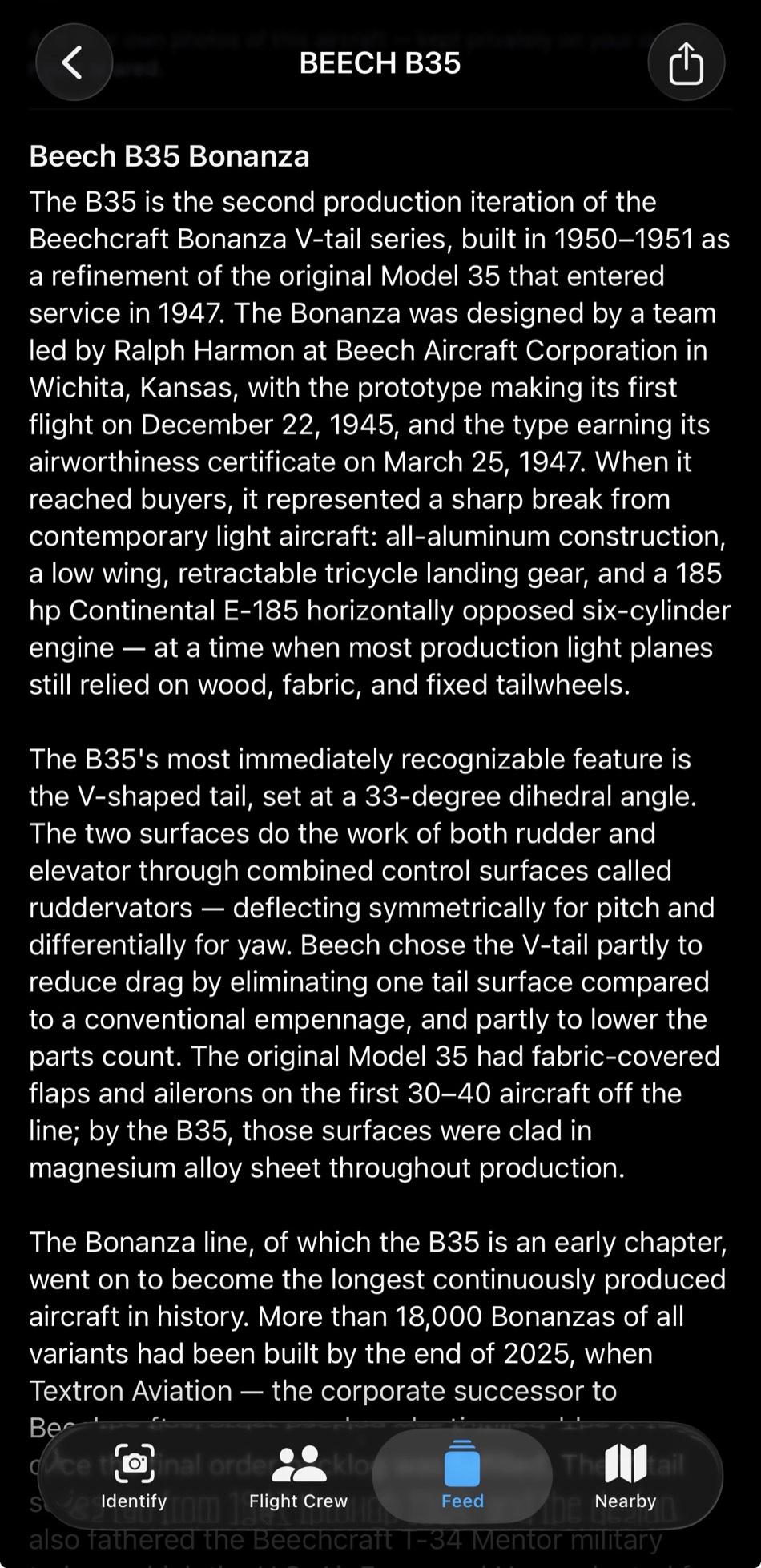
The Fly-in Spotter app showing a Beech B35 Bonanza (N23GH) parked at a fly-in — tail number, type, and a spec card with power, cruise, range, and engine — above the Identify, Flight Crew, Feed, and Nearby tabs The same aircraft's tour-guide story in the app — the Beech B35 Bonanza's V-tail history, design, and production run
Tap for the story

The exact airframe

Tail number, country, year, and engine — pulled straight from the official US & Canadian registries. N23GH · 1950 · Continental E225.

The story behind it

Every aircraft gets a written tour-guide story — history and specs. “The B35 is the second production Bonanza V-tail, built 1950–51…”

Built for the flightline

Identify, a shared Flight Crew feed, fly-in check-ins, and a nearby map — all one tap apart.

Real spots

Real planes. Real stories.

Actual aircraft run through the app — identified from a single photo, with a tour-guide story to match.

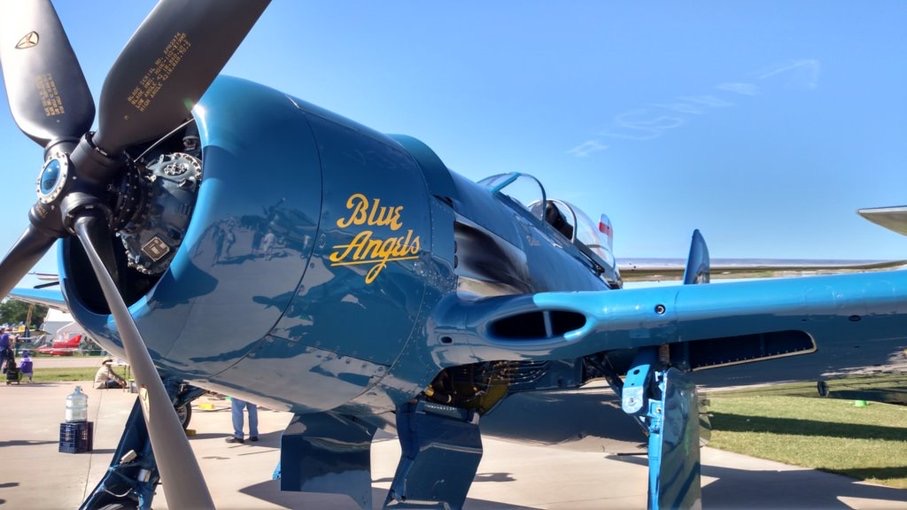
Grumman F8F Bearcat painted in Blue Angels livery
Warbird · “Blue Angels”

Grumman F8F Bearcat

Grumman's answer to combat veterans' one demand after Midway — climb faster. Keep the Hellcat's 2,000-hp R-2800, then cut everything else: five feet of fuselage, seven of wingspan, and add the Navy's first bubble canopy. The G-58 first flew in August 1944 — too late for the war.

The F8F Bearcat was Grumman's answer to a single demand from combat veterans: climb faster. After roughly 18 months analyzing Pacific air combat, the team settled on a simple formula — bolt the most powerful American piston engine available, the 2,000-hp Pratt & Whitney R-2800 Double Wasp, into the smallest, lightest airframe that could still survive carrier landings. The internal designation was G-58, and development began in late 1943.

They started from the F6F Hellcat and cut everything they could. The fuselage came out about 5 ft shorter and was lowered behind the cockpit for a bubble canopy — the first on any U.S. Navy fighter — while the wingspan shrank 7 ft. A 12 ft 7 in four-bladed Aeroproducts propeller replaced the Hellcat's three-bladed unit, internal fuel was capped at 160 U.S. gallons to save weight, and armament was held to four .50-cal Brownings.

The XF8F-1 prototype first flew on 21 August 1944 and entered U.S. Navy service on 21 May 1945 — too late for World War II. Grumman and Eastern Aircraft built 1,265 in all. The type later flew for France in Indochina, then Thailand and South Vietnam, which retired it in 1963. Its second life was on the racecourse: heavily modified Bearcats set piston-engine speed records, and one — Rare Bear — reached 528.33 mph in 1989, a mark that still stands.
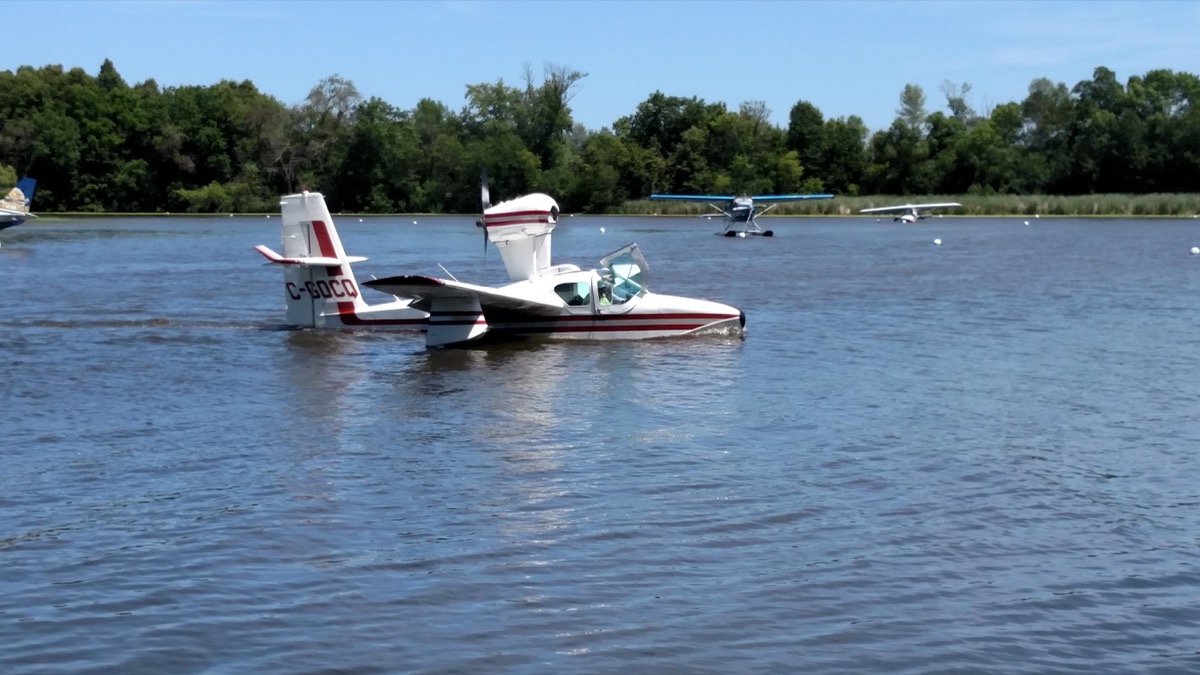
Lake LA-4 amphibian C-GOCQ on the water
Seaplane · Exact match 🇨🇦

Lake LA-4-200 Buccaneer

C-GOCQ · 1974 · matched in the Canadian registry

A four-seat all-metal amphibian — one of the very few light planes built to work routinely from both runways and open water. The giveaway, spotted from fifty feet: the Lycoming sits in a pusher pod on a pylon above the hull, clear of the spray. Thurston's Colonial Skimmer became the LA-4, type-certified in 1960; the 200-hp Buccaneer followed in 1970.

The LA-4-200 Buccaneer is a four-seat, all-metal amphibian — one of the very few light aircraft purpose-built to operate routinely from both paved runways and open water. Its lineage runs back to the Colonial C-1 Skimmer, a three-seat flying boat developed in Sanford, Maine by designer David Thurston. Thurston stretched it into the four-seat C-2; when the brand became Lake Aircraft in 1959, the design gained a four-foot-wider wingspan, a revised nose, and reinforced wing structure, earning FAA type certification on 26 July 1960 as the LA-4 Amphibian.

The Buccaneer arrived in 1970, when Lake swapped the 180-hp Lycoming O-360 for a fuel-injected 200-hp IO-360. Gross weight rose 200 lb to 2,690 lb, and new sponson tanks (7.5 US gallons a side) lifted fuel capacity from 40 to 55 US gallons. The engine sits on a pylon above the hull in pusher configuration, keeping the propeller clear of spray during water operations — the detail that sets the Lake apart from tractor-engined floatplanes. The tricycle gear retracts fully into the single-step hull.

From the flight manual: stall 45 mph, never-exceed 154 mph, range 825 miles, service ceiling 14,700 ft. More than 1,000 were built across the LA-4 and Buccaneer lines. In 1982 a stretched six-seat derivative, the Renegade, followed with a 250-hp or turbocharged 270-hp engine and a longer hull; a military patrol version was marketed as the Seawolf.

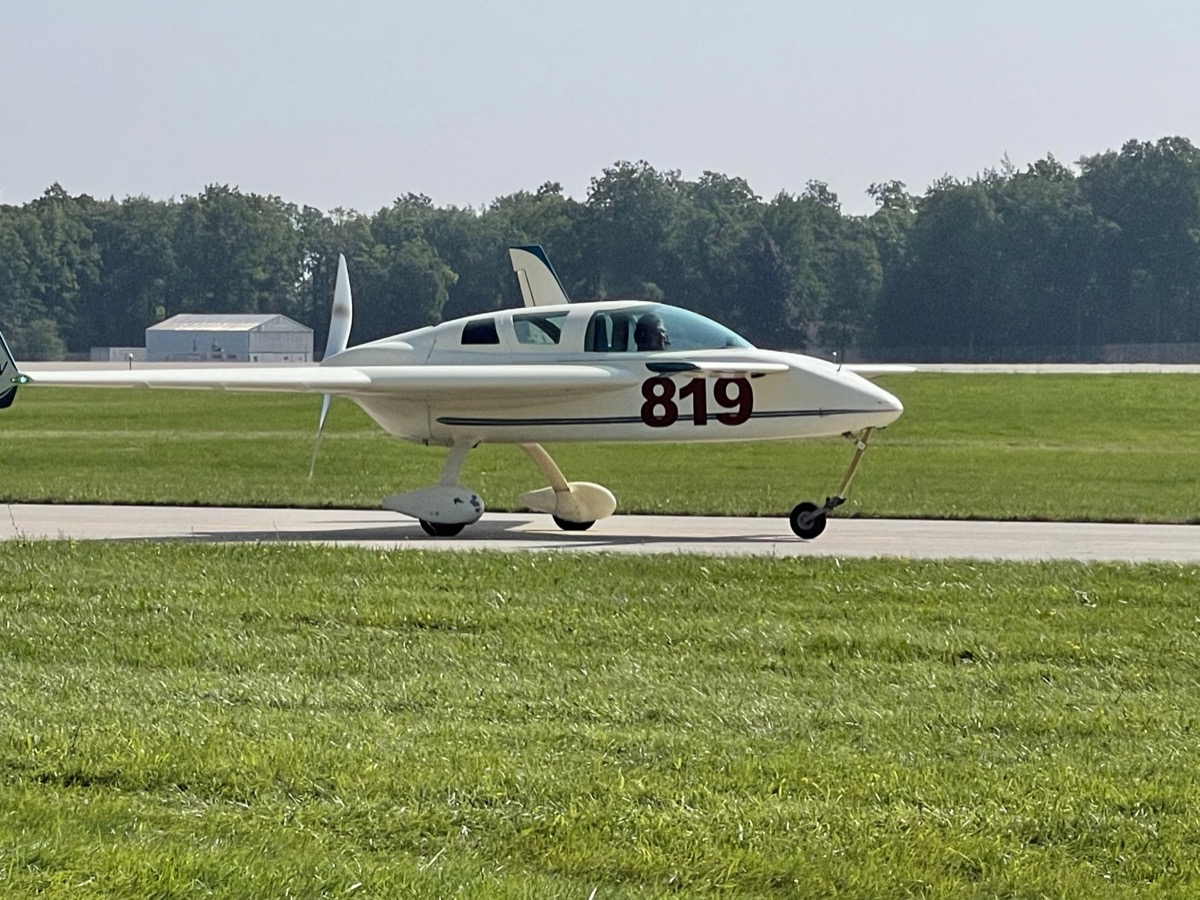
Cozy MK IV canard homebuilt taxiing at a fly-in
Experimental · Canard

Cozy MK IV

Nat Puffer's four-seat development of Rutan's Long-EZ, built with Rutan's explicit approval — plans in 1991, first flight 1993. A moldless foam-and-fiberglass airframe, a 180-hp Lycoming, and a canard sized to stall before the main wing, making a full stall impossible. Roughly 350 completed worldwide.

The Cozy MK IV is a four-seat, single-engine, plans-built canard homebuilt designed by Nat Puffer and derived — with Burt Rutan's explicit approval — from Rutan's two-seat Long-EZ. Puffer introduced it in 1991 and the prototype first flew in 1993. Plans and prefabricated parts come from Aircraft Spruce, but it is strictly plans-built: the builder sources raw materials and fabricates the structure by hand, not from a kit.

The airframe is a foam-and-fiberglass sandwich bonded with epoxy: wing cores hot-wire-cut from blue styrofoam, compound curves like the nose hand-carved from urethane foam, and bulkheads from PVC foam sheet. The recommended engine is a 180-hp Lycoming O-360, though builders have fitted 160 to 220 hp — and at least one example flies on twin Suzuki automobile engines driving contra-rotating propellers.

Like its Long-EZ ancestor, it is a canard: the small forward wing stalls before the main wing can, making a full aerodynamic stall physically impossible. The main gear is fixed and the nose gear retracts, so with the front seats empty the center of gravity sits aft of the main wheels and the aircraft rests nose-down when parked — the “grazing” pose inherited from the Long-EZ. There are no flaps; a retractable belly board slows it on approach. About 350 had been completed worldwide by 2015.

10,000 airplanes. One you can't name.

You're walking the flightline when a gorgeous warbird stops you cold. Two rows over: a home-built experimental, a vintage taildragger, a seaplane up on floats, the everyday production single you learned to fly in. Instead of flipping through a spotter's guide for any of them, you raise your phone — and you're already reading its story. That's the whole idea.

320k+
US aircraft on file
35k+
Canadian aircraft
~2s
to an answer
What's inside

Built for the flightline

Everything findable about a plane — plus the Flight Crew you share it all with. All one tap apart.

Exact airframe match

The tail number unlocks the real record: make, model, year, engine, and seats — not just a guess.

Tour-guide stories

A warm, readable history for each aircraft type — and for famous individual airframes by their nose art. Like a docent in your pocket.

Community-sourced spotting

A live community map shows what's been logged near you and the whole field at the fly-in you're attending — just the location, aircraft type, and the story we generate, never your photos. Tap any spot to read its story.

Your feed & logbook

Every plane you spot lands in your feed — a running timeline of your sightings and your Flight Crew's, newest first. Search it by make, model, or nose art.

Fly-in events

Check in at AirVenture, Sun 'n Fun, and AOPA fly-ins — your check-ins and sightings drop into your Flight Crew's feed, tagged to the event.

Flight Crew

Invite fellow spotters to your Flight Crew, and your saved sightings appear in a feed just for them. Your photos are only ever seen by the crew you choose — never the public. Like, comment, and repost each other's finds.

One tap from your Lock Screen

Add the widget to your Lock Screen and a single tap opens the camera, ready to spot — no unlocking, no hunting for the app. The plane won't wait.

Hear it read aloud

Tap listen and the app narrates the story out loud — keep walking the flightline while you learn.

Stories in your language

Every story reads in your phone's language, or pick one yourself — translated on demand.